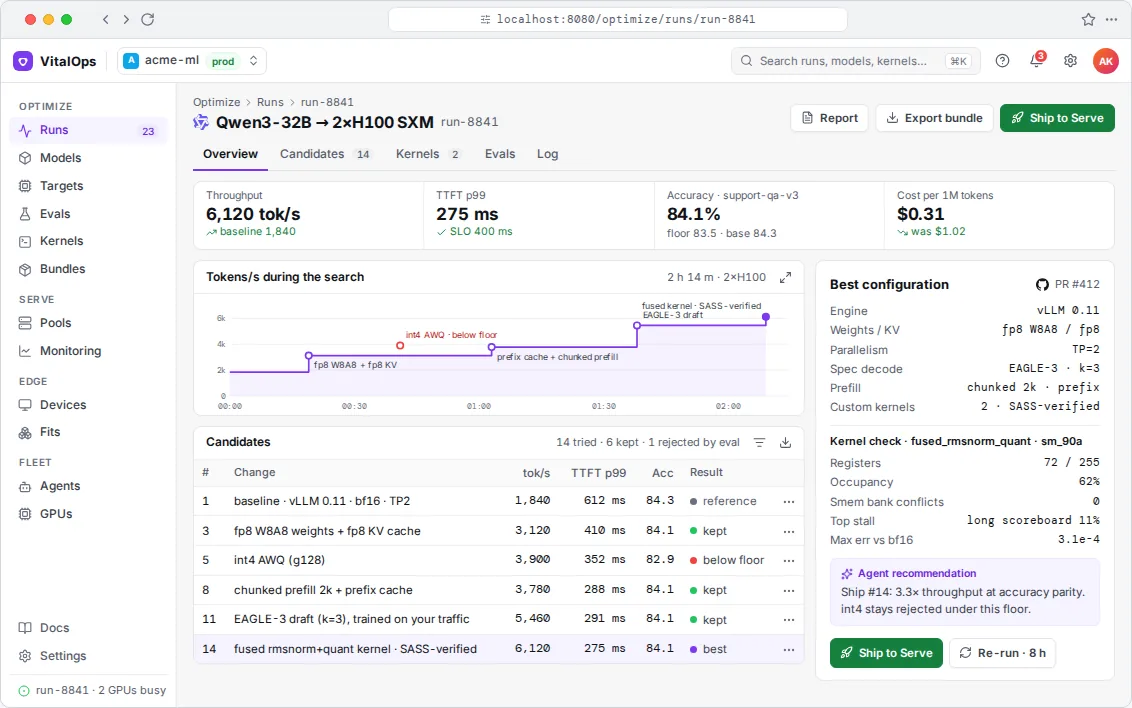
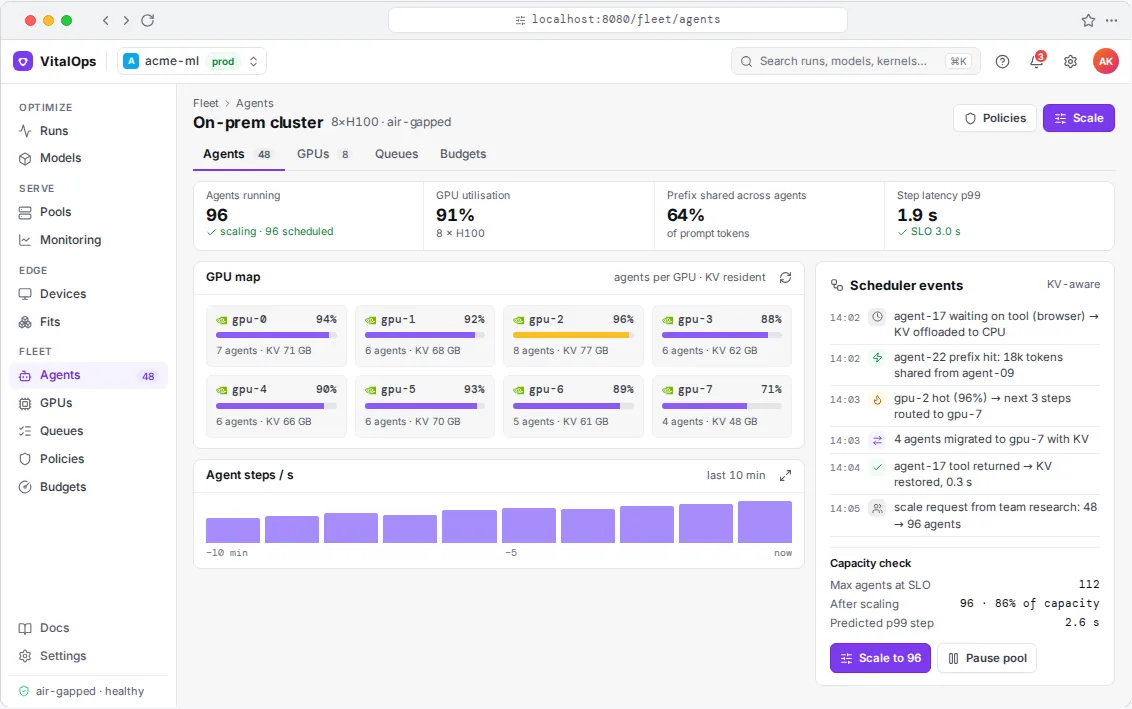
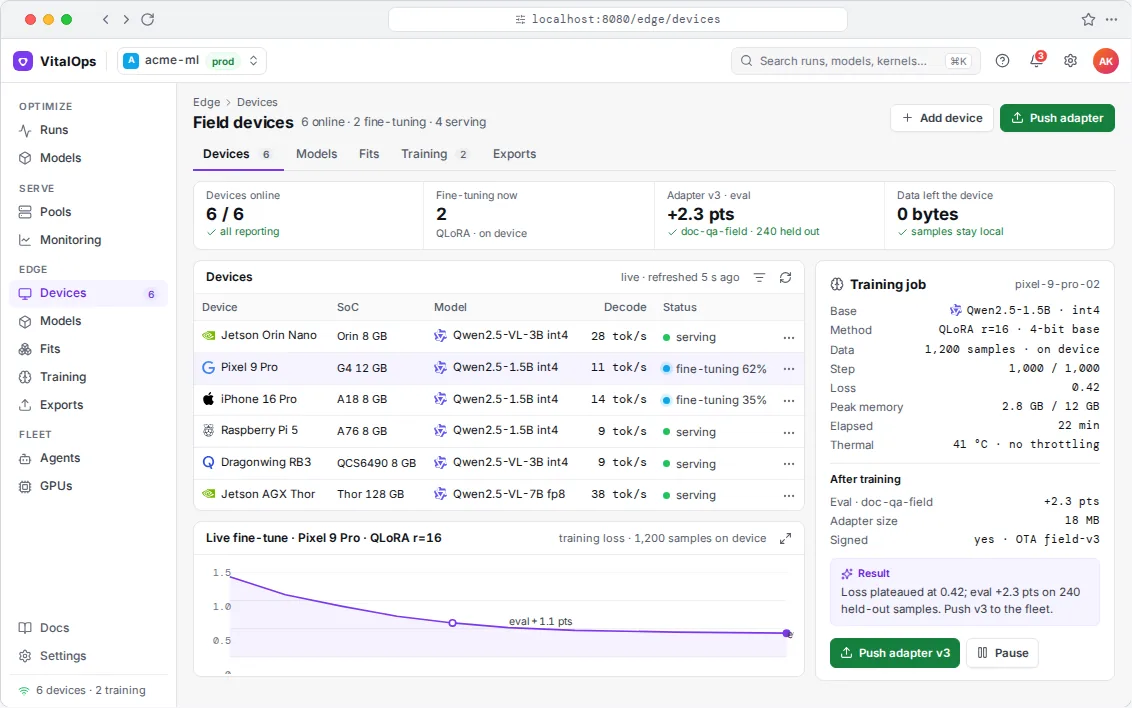
Serve is an OpenAI-compatible model server that runs Optimize bundles. It supports several models per pool, continuous batching, prefix caching, chunked prefill, speculative decoding and structured output, along with canary rollouts and monitoring. It runs in your cloud account or data centre.
Serve tracks time to first token, time per output token, tokens per second, KV-cache hit rate, queue depth, cost per million tokens and output quality. You can break these down by model, pool, tenant and prompt template. When a metric gets worse, Serve suggests a fix and can pass it to Optimize.
See what a prompt change costs within an hour.
Sampled evals flag drops in output quality.
Also works with existing vLLM, SGLang and TensorRT-LLM deployments.
A simulated model server under static batching, continuous batching, chunked prefill and prefix caching, with time to first token and inter-token latency measured on the same requests.
Features
What's included
OpenAI-compatible API
Supports /v1/chat/completions, /v1/embeddings, tool calls, and JSON-schema and grammar-constrained output. Existing SDKs only need a new base URL.
Rollouts
Canaries, traffic splits, shadow traffic and rollback, with a side-by-side comparison against the previous release.
Inference metrics
Exports to Prometheus and OpenTelemetry, comes with Grafana dashboards, and sends alerts to PagerDuty and Slack.
Works with
OpenAI SDKs, LangChain and LlamaIndex · Kubernetes and Slurm · NVIDIA and AMD GPUs · Prometheus, OpenTelemetry, Grafana, PagerDuty and Slack.
No. Bundles can be exported to standard vLLM, SGLang and TensorRT-LLM. Serve adds rollouts, monitoring and the link back to Optimize.
Can it monitor our existing deployment?
Yes. It connects to existing vLLM, SGLang and TensorRT-LLM servers through their metrics endpoints and a small sidecar.
Where does it run?
In your cloud account or data centre, including air-gapped environments. We don't see your prompts or outputs.
Get started
Tell us what you need the model to do
Send us the model, the hardware and your target, whether that's tokens per second, latency, memory or cost. In a 30-minute call we'll tell you whether we think it's doable and roughly what it would take.